Pages

Friday, November 18, 2011

the penultimate hit, chapter 8: roy's tale

by horace p sternwall

editorial consultant and executive producer: dan leo

illustrations by roy dismas and rhoda penmarq


"all right, where were we?"

"i was telling you about what happened in - in - i'm not sure where."

"that's all right, it probably doesn't matter - "

"i think it was bangkok."

"bangkok is always good. you can't go wrong with bangkok."

"it was someplace exotic."

"that sounds like bangkok."

"bangkok is exotic."

"especially the back streets."

"yeah."

"so what happened to you, roy, or what you saw - was it in a back street?"

"i'll say!"

"good. now we're getting somewhere."


for complete episode, click here

Thursday, November 17, 2011

“A Town Called Disdain”, Episode 102: atomic

The master novelist (and bon vivant) Larry Winchester now returns to a couple of his more beloved characters whom we haven’t seen in a month or three: the town physician Doc Goldwasser and rancher Big Jake Johnstone…

(Go here for our previous chapter, or here to start the whole damn thing.)


Roger Miller’s “Dang Me” came on, and the Doc reached over and switched the car radio off.

“S’matter, Doc,” said Big Jake, “doncha like Roger Miller?”

“Not particularly,” said Doc Goldwasser.

Big Jake barreled his red 1969 Cadillac Coupe de Ville through the night along the worn desert road.

Dang me!” he sang. “Dang me!” And then he took a good draw on a fat Monte Cristo with the ring still on it.

The top was down, the desert sky was bright with stars.

The Doc pressed in the dashboard lighter and took a pack of Old Golds out of his side jacket pocket.

Up ahead a couple of miles lay the dark, never-lived-in Atomic Town, or what remained of it after that H-bomb test back in ’59 followed by years of pillaging from locals unafraid of or ignorant of the perils of radiation.

Oughta take a rope and hang me!” sang Jake.

The Doc stuck a cigarette into his mouth and waited for the lighter to pop.

Hang me from the fuckin’ highest tree!” sang Big Jake, and he reached down into the footspace and came up with a pint can of Pabst Blue Ribbon. Holding the red leather-covered steering wheel with his elbows he pulled the pop-top and white beer-foam sprayed up and all over his fat gut. He pulled his arms away from the wheel and the Cadillac swerved out into the desert.

The Doc grabbed onto the dashboard.

“Jesus Christ, Jake --”

Jake let out a whoop and grabbed the wheel with his left hand while pouring beer into his wide-open upraised mouth with his right hand.

Wiping his mouth on his embroidered cowboy jacket sleeve he wheeled the bucking and rocking car back onto the road without taking his foot off the gas pedal.

“Don’t you worry, Doc. What we gonna run into out here, anyhow? Some li’l ol’ kangaroo rat maybe? Naw, even them kangaroo rats don’t live out chyere.”

Jake’s accent had gotten progressively thicker all night, just as it always did after the first beer (and this was his ninth or tenth plus a couple or three whiskeys), forget about the fact that his old man had sent him to Andover for prep school and Dartmouth for college.

The Cadillac’s headlights now faintly illuminated the white husks of the outlying houses of the Atomic Town.

“Hey, Doc, whatcha gonna do we find that flyin’ saucer?”

The Doc had his fingers on the lighter handle, and now it finally popped.

“I’m gonna ask the spacemen to take me with them,” he said.

He lit his cigarette and put the lighter back into its socket.

“Hey, Doc,” said Big Jake, his whole life he’d never been able to keep his mouth shut for thirty seconds straight and he wasn’t about to start now, “hey, Doc, ya ever just jump in the jeep and take a joyride out here, you know, just for the hell of it like?”

“No,” said the Doc, not bothering to say that he never went anywhere just for the hell of it.

“I do,” said Big Jake. “I like to drive out here sometimes. Look at the empty houses. Empty church. Empty town hall. Empty streets and town square. Quiet as hell. Empty fuckin’ desert all around ya. Kinda like a vision of the fuckin’ end of the world.” He took a long draw on his fat cigar and then let the smoke trail slowly out the side of his mouth and over his shoulder and off into the night. “The fuckin’ end of the world."

The Doc always avoided looking at Big Jake if he didn’t have to but now he did, for a second or two anyway.

“Didn’t know you were a poet, Jake.”

“Oh, I got my poetic side,” said Jake, and then he broke into song again. “Dang me! Dang me! Oughta take a rope and hang me! Hang me from the highest tree!

The Doc reached over and turned the radio back on. Tom Jones came on, singing “The Green Green Grass of Home”. The Doc turned the dial and then it was “Sugar, Sugar” by the Archies. He switched the radio off and then he flinched and grunted in pain, just as if he’d been struck in the back of the head with a lead pipe.

“Fuck,” he said, putting his hand behind his right ear.

Jake turned and looked.

“Your head ailin’ ya, Doc?”

“Fuck,” said the Doc.

His face tight and pale as paper, the Doc tossed his cigarette out of the car, reached into his inside jacket pocket and took out the small brown medicine bottle. He struggled with the cap.

“Need your medicine, huh, Doc?”

“Shit,” said the Doc. “Fucking shit.”

Finally he got the cap off, he lifted the bottle to his mouth and took a good gulp. He held very still for a few seconds, his eyes closed. Then, his eyes still closed, he re-capped the bottle and lowered it to his side. His face was still tight, but now he opened his eyes. He began to breathe deeply and slowly. He put the bottle back into his jacket pocket.

“Better now, Doc?” asked Jake.

“It will be.”

“Got nothin’ but respect for you guys got wounded in the war, Doc. Nothin’ but respect. I was lucky, never got too near combat myself. Not that I wasn’t willin’, but -- you know the army, the army figgers out what it wants you to do, not you, and you damn well better do it. In my case it was be a supply sergeant. But lemme tell ya, I do say so myself, I was gonna be a supply sergeant? Well, sir, I was gonna be a damn good supply sergeant, yes sir. And again if I say so myself I don’t think there was another supply sergeant in the whole damn ETO who --”

“Jake --”

“Yeah, Doc.”

“Can we -- just be quiet for a while?”

“Yeah, sure, Doc, sure. Sorry.”

Jake drove on, closer to the town, humming “Dang Me” to himself.

The Doc put his hand behind his ear again.

“You got that ringin’ in your ear now, Doc? That there what is it -- tetanitus? Titannicitus? Tintinnicitus?”

“Tinnitus,” said the Doc. “No. Not now.”

“Hurts though, huh?”

“No,” said the Doc. “The pain’s stopped now.”

Jake’s Cadillac now entered the dead and empty streets of the Atomic Town. The windows of the houses and buildings were black and gaping and rimmed with jagged shards of blackened glass, tendrils of ancient shredded curtains undulating in some of them like the hair of drowned old women. Not a single door stood in any doorway, all of them either destroyed by the blast or stolen by looters. A few tumbleweeds blew sadly along the streets but there was not a single specimen of living plant life, not a single desert weed.

Jake slowed the car down, the better to appreciate the sepulchral stillness and devastation of the town.

“Funny,” he said. “Build a whole town just so you can destroy it. Just like everything else in the universe when ya stop and think about it. The good Lord created it all and in due time He in his infinite wisdom will destroy it all, along with you, me, and ever-body else including all the little beasts and children, God love ‘em.”

He glanced over at the Doc, who still held his hand over his ear.

“You sure that ear ain’t still ailin’ ya, Doc?”

“Yeah.”

“Then why you holdin’ your hand on it?”

“Because I’m hearing voices.”

“Voices?”

“Yeah. And music.”

“No shit. What these voices sayin’?”

“I -- I can’t make it out too well.”

“What they sound like?”

“They sound like --”

“Like what?”

“Like a fucking nightmare.”

Suddenly Attie and Cleb Parsons came wheeling out of a side street on two old bicycles and into Jake’s headlights. Brother and sister both glowed a faint green in the bright light, as did their bikes.

Big Jake stopped the car.

“Now what them two kids doin’ way out here on their bikes?”


(Continued here. Soon to be a major motion picture from American International, produced and directed by Larry Winchester, starring Kirk Douglas as the Doc and Slim Pickens as Big Jake.)

Monday, November 14, 2011

Sunday, November 13, 2011

New Life


(Click here for the first episode; here for the previous one.)

Satisfied by brunch, Zach grew happy for no reason other than the spring sunshine, and in his good mood said, “It’s Omaha, Duncan. Tell me what you know.”

“To be honest, not a great deal.” He had met an assistant professor at a gender politics conference in Honolulu. “We only knew each other that one night but he raved about the Omaha campus and his brilliant students. Anyone will tell you UNO’s practical research is highly regarded. I can look up my friend—I’m sure he’d remember me.”

“Please don’t.”

But Duncan looked thin and vulnerable, trying to save his nice new hair from being blown by the wind. Instead of squirming, Zach said, “Let’s wait until the president and chancellor have interviewed me.”

“Do you mean to say the position they’re forcing you into is Dean of the entire Poli-sci department? President and chancellor—what else could it be?”

“It is. You think it’s a promotion?”

Duncan smirked and waved his hands as if Zach’s complaint had been a bad joke. Which made Zach wonder—maybe it was. Had certain members at the Younger Institute not claimed Vida as their princess whose honor he had failed to uphold, never mind that he was merely abiding her wishes, Dorothy wouldn’t be telling him to leave. But perhaps that was only one factor. She might have sounded him out even if he were still among the rainmakers. She knew, as did everyone, Zach was getting divorced. He wasn’t tied to New York. If Nebraska’s not-insignificant Poli-sci department wanted leadership, who better than Zach?

As he and Duncan walked along the river, Zach recalled his dynamic style and positive energy, both badly sapped by tearing apart his and Beth’s hideously conjoined identities. That, thank God, was finished. Time to reclaim his vast powers of persuasion and charm; his clean, honest ambition. All his magnetic force surged through him—or resurged.

Duncan asked, “What’s the rush?”

For Zach had increased the pace. While slaying his monstrous marriage for nearly a year now, he had lost the habit of tapping into his fount of determination. Reinvigorated, he only needed to see Vida to win her forever. She had wanted to marry him as recently as last year. Instead of bowing to her restrictions, he should have wooed her with all his charm. Rather than slavishly follow her into the lap of luxury where his furious energies fell into a sweet lull, almost a slumber. No more!

Clamping a hand on his friend’s shoulder—a first, Zach touching Duncan rather than flinching from him—he thanked him for pointing out the only way.

They rounded a corner and Zach said his love for Vida superseded all other goals. Duncan recited an amorous phrase.

“Is that from a famous poem?”

“No, the lyrics from an old torch song. I’ll email it to you.”

“Ordinarily, Duncan, I’d say no thanks. But to get Vida back, I need fresh bait.”

“Don’t think of it like that.” He shook his head. “You’re following your heart, Zach and need to tell her that. Admit you let too much time pass just because she said so, when if you had been true to yourself you would have shouted your love for her into the night every night! But now the day has come when you cannot hold back. She must accept your love for what it is—whether she shares it or not.”

“Exactly,” Zach said. “Better late than never.”

Duncan sighed. “Have you ever suffered unrequited love, Zach?”

“It doesn’t exist.”

“You might find out differently. Be prepared.”

He laughed. “You do know that’s my motto, right?”

Hurrying to his apartment in Lenfest Hall, Zach pulled out an iPad and declared his love just as Duncan had described it. He had never written a love letter and never imagined he would.

Dear Vida, I’m writing from my heart, he wrote. No proofreading, no revision: I refuse to take back a single word. My love for you is unbound and uncalculated from now on.

He sent the email. And when he saw her—either this evening or tomorrow morning—he would break the news about Nebraska.  He was starting to play Sudoku when she called.

“Zach, you cannot visit me.”

“I must, Vida.”

“You must not. You cannot. My sister Samantha is here. She’s taking care of me.”

“That’s wonderful. I’ll see you tomorrow.”

“No! Zach. Don’t come. You’re not invited.”

“But two days ago—you said… Vida, I’ve told my wife about the babies. And am pushing full speed ahead on the divorce because I want to marry you.  I need to be with you.”

“During the last two days, Zach, I’ve changed my mind.”

“Why?”

“Having you here would make me uncomfortable. You haven’t seen me in months. Then, too, I owe Samantha. She hates you, Zach. And if she knew you better, she’d hate you more. And you would hate her. Think of the kind of woman you hate the most and intensify everything about her—that’s Samantha. The two of you wouldn’t last ten minutes in the same room.”

“Vida, you don’t know that. But you’re right about us not having seen each other in months. You don’t know how I’ve reclaimed my powers now that I’m free. Remember my enthusiasm? Remember my terrific charm? My magnetism? Intensify them and—that’s me now.”

Vida hung up and the next morning Zach visited a jeweler who designed a ring for her. A big, pink sapphire flanked by twin pink pearls. He sent her another email, quoting the Johnny Hartman ballad Duncan had downloaded for him. He considered just sending her the song but if she were distracted, she might not get the lyrics that Duncan found so moving: “A lifetime with you would be one heavenly day...”  

He spoke to his lawyer, saying “Give Beth whatever she demands. I want to marry someone else.” Convinced that the position in Omaha was indeed a promotion, he arranged for an interview next week. The UNO president sounded excited. If Zach could stay two days, he said, the chancellor and vice chancellor would be equally eager to meet him.

He was crossing the campus when his phone rang in his pants. Vida’s sister, Samantha Freeman said, “She had a C-section an hour ago.”

“She did? Is Vida all right? And the babies?”

“They’re all doing well. Both girls weigh more than five pounds. They’re perfect. Excellent apgars.”

“Excellent apgars!” Zach shouted. “Can I talk to Vida?”

“She’s still in recovery.”

“I’m on the next plane.”

(click here for the next episode)

Saturday, November 12, 2011

out of season...

by nooshin azadi

illustration by rhoda penmarq


.

they say
it's spring
but dried leaves of dogmatism
are falling down
the tree of mind

guided winds of change blow freely
and my words shiver in the cold

.


Friday, November 11, 2011

JUST Desserts

by peter greene

illustrations by rhoda penmarq


JUST Desserts


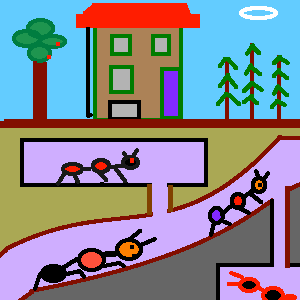
Ants
can be so ungainly
lumbering along , this

one
is red and black. I could swear
it tilts its rough-hewn head up
to regard me, slayer ,or saviour even -for do i
not grant freedom to each
one that comes my way?I certainly


try to. Red-black mottled body
on red-orange fir floor -looking up at me,


as i descend ,kleenex
of blackness
in hand- down, do wn the cold toilet whirl
to a slow death in septic fluid -broken, they still live,
these ants, broken they still live . Behind me
a dozen of his brothers bastards all, by
one such thousand - slut
of a mother - bastards, behind me


they are making free with my new bought fruίt, they are


seeking out the wine they are
making trail
for the hidden cupboard, full of crumbs , where
rings of oil and vinegar , old jars, and forgotten
bits
of cat food rot- and
why should they knot? Bastards.


I'll kill them if i can- but i, alone, a man
stand no chance- below my house there is a city
i would find more terrifying
by far
than these bold soldiers find my floor. Fuckers!
I hope i never fall in there , i hope
peace reigns
while i wage genocide - if they
realized
what i was up to , I
wouldn't wake up, to
morrow or ever again -unseen my


ground-up bones would line the deepest throne -room passage
walls
and my
teeth, such broken things they are, would pave the floor-
the orbits of my eyes
would fill with black -legged forms,
de
vourers, military takers
of all flesh -we , too


behave like this!


©Peter Greene 2011.


Thursday, November 10, 2011

"A Town Called Disdain", Episode 101: dang me


In our previous episode, Daphne’s father -- “Mac” MacNamara -- told his daughter Daphne of his first meeting with her mother during a V-1 bombardment in 1944 London. But, meanwhile, what of that wacky pair Derek and Paco, stoned out of their gourds in Paco’s comfy Quonset hut? For that matter, what’s up with Enid and Hope, surrounded by the bloodthirsty and uncouth Motorpsychos?


(Click here to go to the very first chapter of the epic of which Cormac McCarthy said (in an out-take from his appearance on Oprah), "I wish I could write a motherfucking book like that.")

Derek, his blackened lungs full, passed the joint to Paco as the violins soared from the TV set.

Staring at the TV screen -- the officer gazing at the uniformed woman and she staring back at him from under her cap, cigarette smoke merging with the dust swirling around them -- Paco toked on the joint and lifted an “Archie and Veronica” jelly jar of his murky homemade pulque to his lips, drank, swallowed, and then slowly exhaled the smoke.

“Movie’s freakin’ me out, man,” said Derek, pouring some of the pulque from a quart fruit jar into a Flintstones glass.

“That ain’t no movie,” said Paco.

A Muriel Cigars commercial with three Edie Adamses came on.

Derek took a drink of the milky stuff, and after watching Edie Adams time three for half a minute he said:

“What?”

“What what?” said Paco.

“It ain’t a movie?”

“No, man. Those are your friends in that movie. That movie ain’t no movie. It’s real. It’s happening.”

He passed the joint back to Derek, and Derek took a hit.

“What’s even heavier,” said Paco, “we’re in the movie too.”

Derek let out the smoke. The three Edie Adamses danced and sang on the TV.

“That’s heavy,” he said. “Three Edie Adamses.”

“Yeah,” said Paco. “Even one Edie Adams is some heavy shit.”

The commercial went off, and all three Edie Adamses with it.

The TV now showed a ’54 Dodge flatbed truck barreling down a dark desert road, with a ragged band of motorcyclists cruising along in front, on both sides, and behind. The cyclists all carried pistols, shotguns, or submachine guns. Heavily reverberated electric guitar music played on the soundtrack.

“Oy,” said Derek.

“Motorcycle movie,” said Paco.

“Fuckin’ love these movies, man,” said Derek, and he handed the joint back to Paco.

****

Hope drove, an intent look on her face, the draft whipping her dark hair over her leather-clad shoulders.

A Royal Marine commando knife was stuck into her belt.

Next to her sat Enid and then Moloch. Enid held the business end of her cocked and locked .45 pressed against Moloch’s left temple, her thumb on the safety, her finger on the trigger; his head was stuck halfway out the window, his Nazi cap had fallen off, his long greasy hair flowed in the air like dark yellow seaweed. Moloch’s Webley revolver was stuck into Enid’s jeans waistband. His hands were tied behind his back with his ratty old Magdalen College scarf.

Outside the truck the accompanying Motorpsychos roared blurrily along.

“God, you stink, Moloch,” said Enid. “How can you stand yourself?

“Ah, but that’s the point, my dear lady -- I cannot stand myself.”

Moloch turned his face toward Enid, smiling with his cracked and stained teeth and his ravaged lips, his mirrored Raybans flashing, and then he stuck out his leathery grey and pitted tongue.

With the muzzle of the .45 pressed against his forehead Enid pushed Moloch’s head back out the window.

“Don’t move, Moloch. Don’t even budge.”

“God, he’s so gross,” said Hope.

“Compliments,” said Moloch, his voice a bit strained what with the awkward position of his head and neck, “will avail you naught, my tender and soon to be devoured little mollusk.”

Enid rapped Moloch hard on the temple with the barrel of the .45, and then shoved it against his skull, pushing it farther out the window.


Moloch’s comrade Testicle rode along outside the passenger window of the truck. A large, bearded, toad-like man in a Nazi helmet and filthy denims and leather, in other words no different from thousands of other motorcycle renegades, he carried strapped to his chest a sawed-off Remington 7188 automatic shotgun with an eight-round magazine.

“Huzzah, Testicle!” cried Moloch.

“Huzzah, Moloch!” cried Testicle, overjoyed at having been so singled out.

Inside the truck Enid said, “Okay, not another word, Moloch, or I pull the trigger.”

“Oh, but I don’t think you will, Miss Enid.”

“Don’t bet on it, pal.”

“No, I don’t think you will,” he said, “because if you did, that very moment my comrades would descend upon you and this moist little sweetmeat like the mindless barbarians they are, and they will rip you apart by your --”

Enid brought the gun down and shoved it into Moloch’s crotch.

“Oh,” he said, gritting his teeth.

“Yeah,” she said. “’Oh.’”

“Oh dear,” he said.

“First you get it in the balls, Moloch.”

“Oh yes,” he said. “Yes, quite.”

She shoved the gun in harder.

“Yes,” said Moloch, “yes, yes, harder, please, like that.”

“Oh my God,” said Hope.

Enid brought the pistol up quickly and whacked Moloch hard across the jaw.

He slumped against the door, smiling dreamily behind his mirrored Raybans.

“Step on it, Hope,” said Enid.

Hope stepped on it, pressing the pedal all the way to the floor and running a couple of the Motorpsychos off the road. The way ahead was clear now. She reached up to the transistor radio duct-taped to the rearview mirror brace, switched it on and Roger Miller came on:

Dang me, dang me
They oughta take a rope and hang me
High from the highest tree
Woman would you weep for me?


(To be breathlessly continued.)