edited by professor dan leo
illustrated by rhoda penmarq
executive producer: kathleen maher
part fifteen of fifteen
to begin at the beginning, click here
  We went past the last of the boardwalk shops and amusements and onto that long stretch of the promenade on which people must fall back on the clean ocean air and the sight and sounds of the ocean and the beauty of the enormous twinkling sky, or their own devices, to ward off boredom and dread. “How is your leg?” asked Clarissa. I had forgotten that I was limping, just as I had forgotten that my leg hurt, but now that she mentioned it of course I became aware of both limp and pain.  “It’s okay,” I said. “I really seem to have found myself in a pickle,” she said, getting back to herself. “What I’ll need to do is find some rich man and marry him. Something I should have done a long time ago. Do you have any rich friends, Arnold?” “No, I’m afraid not,” I said.  Not that I would have introduced her even if I had a rich friend. “Perhaps I might stay with you and your family as a guest for a while? Just until I shop around and find a husband?” What had I got myself into? I needed to think, and to think fast.  “Clarissa,” I said. “I so love it when you say my name like that. Say it again.” “Clarissa.” 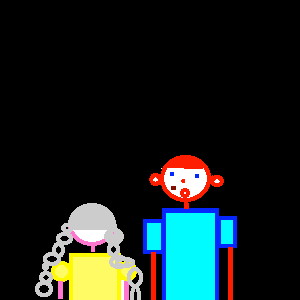 “Love it. Do go on.” “Clarissa --” “Yes!”  “If I’m not mistaken it was some bargain you made with Jack Scratch that turned you into a doll?” “Yes. Drat my vanity. You see I wanted never to grow old. What Jack didn’t tell me, and what I didn’t bother to read in the fine print of his contract, was that I would spend my eternal youth as a damned doll. Pardon my language.” “And this was when? What year?”  “Nineteen hundred and ten.” “Okay. Well, how would you like to go back to 1910?” “Oh, that would be marvelous. I’m sure my family is wondering where I am. Do you think you could take me back?” “I can try.”  “You are resourceful, Arnold.” “We’ll see. Let’s stop for a moment.” “My, this is exciting,” she said. “Let’s go over and look at the ocean,” I said.  We went over to the beachward rail, and we looked out at the grey empty beach, at the surf and the dark sea. “Now what happens?” she asked. “I’m not sure,” I said, “but I think we should stare out at the ocean.” “The ancient, timeless, eternal ocean?”  “Right.” So we stared, for a minute or so. I tried to concentrate, to see the wholeness of time instead of the continuous flickerings of present moments in which we ordinarily live. And then I saw a German U-Boat emerge from the waves only a few hundred yards from the shore, the gleaming water streaming from its conning tower in the starlight as the dark boat slid though the swells and down toward the cape and the bay. I saw steamships from the turn of the century and then came the wooden ships, the three-masted frigates and schooners and men-of-war, I saw the canoes of the Indians and even the longships of the Norsemen.  And then there was only the dark and huge unquiet ocean. “This is rather dull,” said Clarissa.  “Bear with me,” I said. “Tell me, when you made this deal with Jack Scratch, were you staying here in Cape May?” “Yes, my family and I were stopping at that dreadful Admiral Hotel down the road. Do you know it?” “Yes.” I had on many occasions walked by this enormous pile of brick and concrete, which had recently been bought by the Reverend McIntyre and re-named The Christian Admiral.  “All right,” I said. “I’m going to give this a try.” “To take me back?” “Yes.”  “How thrilling! What do I do?” “Keep holding my arm.” “Ooh, your strong manly arm. Do you exercise with dumbbells, Arnold?”  “No, but I swim a lot. Now try to concentrate, Clarissa.” “Sorry. I will.” “Okay, let’s start walking, nice and easy.” “Anything you say.”  We resumed out stroll. “Look ahead,” I said. “Do you see the Admiral down there?” “How can I not? It’s hideous, isn’t it?”  It was about four blocks away up the curve of the beach, looming huge and monstrous, set apart from the mostly beautiful downtown area of Cape May, and just as well. “All right,” I said. “Let’s just keep walking.” A young couple were coming down the boardwalk. The boy wore a white t-shirt with rolled up sleeves, and blue jeans. His heavily greased hair was swept back in a ducktail. His girlfriend wore a full dress with white socks and Mary Jane shoes.  The young couple passed us, and then another slightly older couple approached. The man wore an army summer uniform of the sort I had been issued during the war. The girl had her long hair scooped up above her forehead in the fashion of those days. “Those people look somehow odd,” whispered Clarissa. “I know,” I said, as we passed the couple. “It’s happening quicker than I had hoped. I think we’re in the mid-1940s.”  “Oh, how wonderful!” “I’ll need your help, Clarissa. When you see people who seem dressed like in 1910, tell me.” “Dressed as in 1910,” she corrected me.  “As,” I said. A 1930’s couple came up next, the man with the thin moustache and shiny hair of Clark Gable, the woman with the platinum helmet of Jean Harlow.  And so we walked back through time, through the 1920s and into the teens. By the time we reached Pittsburgh Avenue and the block dominated by the Admiral Hotel the streetlights had changed from electric to flickering gas. “I think we’re back in my own time now,” Clarissa said. “Or close enough.”  There was no one nearby on the boardwalk, but an open Oldsmobile Limited touring car rolled past us along Beach Drive. The men in the car wore straw boaters; great multi-colored hats like tropical shrubs sat on the heads of the women.  Clarissa let go of my arm, and turned to face me. I realized that she was wearing one of those large hats, festooned with blossoms made of satin and silk. Her dress came down to her patent leather boots, and looking down I saw that I was wearing a white suit from the epoch, complete with spats. It occurred to me that people must have been very uncomfortable in summer in these clothes. I know I was sweating.  “Will you come with me?” she asked. “I’d better not,” I said. “It’s late, and --” “Yes?”  “I’m afraid of getting stuck here in 1910,” I said. “I can understand that.” She turned and looked across the street at the hotel. “I suppose I can manage it from here.” She paused.  “Well, thank you, Arnold. Thank you ever so much.” “You’re welcome, Clarissa.” “I suppose I’ll have to go back to being mortal now,” she said.  “Maybe there are worse fates,” I said. “Don’t I know it.” Behind us the surf crashed gently, sounding the same as it always does.  “Well, ta,” she said. “Goodbye,” I said. “Perhaps we’ll meet again.”  “That’s possible, I guess.” “I’ll be so much older than you.” “Yes.”  “More’s the pity. I could get along with a man like you.” She went up on her toes and gave me a kiss on the cheek. “All right,” she said, “no sad goodbyes! Wish me luck!” “Good luck, Clarissa.”  There were some steps there, and she flounced down them to the street. Before crossing though she looked back. “Come visit me sometime, Mr. Schnabel!” I shrugged. “Maybe,” I said.  “Ha!” She started across the road. A carriage with two horses was coming right toward her, but the driver reined in and put on his brakes. On the opposite sidewalk Clarissa headed purposefully toward the hotel entrance. I watched her float up the two flights of steps, across the portico, and through the front doors.  I waited for a minute, just to make sure she was well in and not being chased or thrown out.  Then I turned, and I headed back down the boardwalk.  The years and the decades drifted past me, and by the time I reached Convention Hall I was back in what looked to be 1963.  I looked down at myself and I was once again wearing my polo shirt, my bermudas, my Keds with no socks. I heard the rock ‘n’ roll of Rockin’ Harry Hirsch and his men booming from within the hall. I stopped by the steps that led down to the drive and to the movie theatre across the way. I took out my packet of Pall Malls, and the book of matches.  The whole time I had been with Clarissa I had thought I wanted to be free of her. But now I missed her. and of the cautionary tale of Clarissa the Doll  
|