Pages

Sunday, November 21, 2010

an unfortunate accident : part 1

by dan leo

illustrations by rhoda penmarq and konrad kraus

part one of four

Extracted from Arnold Schnabel's 37-volume memoir, "Railroad Train To Heaven"


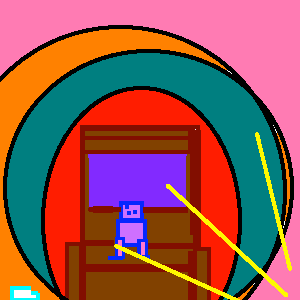
She threw down the puff and rose from the chair. She wore a silky sort of shimmering gown like the color of moonlight. She came to me and put her hands on my arms and looked up at me.

“Kiss me,” she said.

I did, but briefly.

She drew back a bit, still holding onto my arms and looking up at me from under her lowered eyebrows, which were plucked pen-line thin.


“You’re not cross with me for over-napping, are you?”

“No,” I said. “I was napping myself.”

“Good. Shall we go out onto the veranda?”

“Okay,” I said.

She took my arm and we went across the room to the open French doors. A little breakfast table with a few matching chairs was out there, but she said, “No, darling, over here, side by side.” And she pulled my arm and led me to a small wicker sofa strewn with varicolored pillows, cushions, and scarves.


She gently sat down, drawing her legs up under her and, turning to look up at me, she patted the place next to her.

I sat down.


I looked out through the screening of the veranda, down at the grounds and buildings of the plantation, out at the jungle-covered hills and up at the enormous burnished-steel sky. A hushing warm breeze came down over the tops of the trees, and somewhere a parrot squawked thinly, like a human baby with the colic. The air smelled of coconuts and sugarcane, of pineapple and raw tobacco. And of Mrs. Biddle's perfume. My skin was moist under my suit.

“Cigarette, darling?”


She reached over and flicked open the top of a silver cigarette box on the long low glass-topped table in front of the sofa.

“No thanks,” I said. “I’m trying to quit. Or at least I think I am.”


“Will wonders never cease?” she said. She took out a cigarette, closed the box and tapped the cigarette on its engraved lid.

There was no table-lighter on this coffee-table, so I reached into the pocket of my suit, and I found a lighter. I lit her cigarette.

“Please relax, darling,” she said. “Jimmy’s safely down in Manila.


And Tommy as you might or might not know, is the absolute soul of discretion. I’m so glad you came. I’ve been thinking about you nonstop. Simply nonstop.”

“God knows what you think about,” I said.

“What do you mean?”


“When you think about me,” I said. “I’m myself twenty-four hours a day, and, believe me, it’s not that fascinating.”

“That’s just one of the things I love about you, Arnold, your almost complete lack of narcissism.”

“Perhaps if I were someone else I would be more narcissistic.”


“Where’s Tommy with that tea?” she asked, I suppose rhetorically. “I’ve given the servants the afternoon off by the way. It’s only you and me and Tommy in the house. My daughter is visiting with one of her little friends. So we shouldn’t have any interruptions.”

She put her hand on mine.

“So,” I said, “what did you want to talk about?”


“Are you decent?” called a voice from within her room.

“Oh, just come in, Tommy,” called Mrs. Biddle.

Tommy came out onto the veranda carrying a very large and ornate tray with a tea service on it.

He laid the tray on the table: a teapot, two cups and saucers, a sugar bowl and a honey bowl, a little silver pitcher of milk or cream.


Tiny little engraved spoons, shiny as drops of rain. There was a pile of small crustless sandwiches on a silver platter, and a couple of small china plates.

“Shall I pour the tea?” asked Tommy.

“No, Tommy, thank you so much; Mr. Schnabel and I are just going to have a little chat for an hour or so.”


“Of course. I’ll be in the drawing room. Listening to the radio. E.M. Forster is coming on with one of his little book-chats.”

“Splendid. Keep an eye on the door, darling, and if anyone comes by send them away. Say I have a headache.”

He smiled and withdrew.


“Now,” she said, picking up the teapot. “First things first. Tea.” She lifted the lid of the pot and smelled the brew. “Ah, strong and piping hot.” She replaced the lid. “I don’t think that Tommy’s spiked it. But we shall see.”

She paused, holding the pot.

“Darling, I just realized I don’t even know how you take your tea.”


“Don’t feel bad, I barely know how I take my tea myself.”

“Milk?”

“Sure.”

“One lump or two?” she asked. “Or honey?”

“What the heck, let’s go with honey. One teaspoonful.”


“That’s exactly how I take it,” she said.

She fixed our tea. I lifted my cup and tasted it: pretty good, actually.

“You like it?” she asked. “Tommy blends it himself. Assam and something else. And sometimes regrettably laudanum. But this --” she licked her lips appraisingly, “seems to be un-spiked. Or, if it is, it’s only just a teeny bit spiked.”

She put down her cup and saucer, took one puff from her cigarette and then stubbed it out in a large cut-glass ashtray.


“Here it comes again,” she said.

She was referring to the rain, which started just then with a smattering of fat drops exploding against the screening of the veranda, and which a moment later turned into an utter downpour, turning the outside world a dark streaming and clattering grey. The only illumination was from a handful of windows glowing like dying suns from the other buildings on the plantation, small blotches of dull swimming light in this submerged world.


“This damned rain,” she said. “Do you ever miss home? Philadelphia?”

“No,” I said, “not really.”


It was good to sit here drinking sweetened strong tea, out of the downpour, sitting with this beautiful lady. I took a bite of a sandwich. Chicken salad. And very good.

“This racket,” she said. “This rain. It sounds like all the heavens are crashing down.”

“Don’t worry,” I said. “They’re not.”

“No, of course they’re not.” She put her hand, the one with a wedding ring on it, onto my knee. “You’re so strong, Arnold. So unflappable.”


“Not particularly,” I said. “These people who work on your plantation. They’re strong.”

“Yes, I suppose they are.” She lifted her hand, flexed and unflexed it. “And I suppose you think I’m horribly spoiled.”

“No,” I said.


“I do work you know. I’m up at seven every morning attending to affairs. Tommy oversees the fields and I deal with the house and the ordering and transport and everything else. While Jimmy drinks. Drinks and gambles. Drinks and whores and gambles.” She looked away, out at the downpour beyond the veranda’s screening. It was like being behind a waterfall. “Perhaps I’ve said too much,” she said.

“Oh, no,” I said.

I tried another sandwich. Pork I believe, also excellent.

“I’m horribly unhappy, Arnold. I no longer love Jimmy; and he has never loved me. He married me for my money, I know that now. But if I divorce him my mother will have a cow, an absolute cow. Catholic you know. And my father will be none too happy either, believe me, as Jimmy took all my money and sank it into this hellhole and it’s all in his name and if I divorce him I know he won’t give me a red cent. What should I do?”

I thought about this a moment, chewing my sandwich.


“Could you wait till Jimmy gets really drunk one day and then have him sign the property over to you?”

She held still for a moment, then took a sip of her tea.

She laid the cup and saucer down.

“That’s actually not a bad idea. I could arrange for our lawyer Dr. Rodriguez to be there, all ready with his contracts and stamps and pens. I’m sure he’d be happy to do it. Dr. Rodriguez is slightly in love with me you see.”


There was a small plate of cookies on the tray also, I hadn’t even noticed them before. I started to reach for one but her hand intercepted mine and pulled it to her breast.


“Feel this,” she said. “Can you feel my heart beating.”

I could, actually.

“Yes,” I said.

I started to pull my hand away, but, not only would she not let go of it, she pulled it under her décolletage and placed it on her right breast, all the while staring into my eyes.


“Um,” I said.

“Don’t you want me, Arnold?”


part two


mary jo, part 4: miranda best

to begin at the beginning, click here


by jesse s mitchell

illustrated by rhoda penmarq


There was a smile on Mary Jo’s face as she pulled to a dusty stop along the line of gas pumps staring out at the road like one-eyed monsters.  The sky above her was solid black glass, obsidian, perfect. The moon was everywhere.  She filled her tank and walked under the tungsten-lit awning into the building.


 As she walked in, she saw the tall outline of the cashier.  A girl no more than 18 with huge hair in tight spirals all around her head and tied back with a camouflage rag that matched her pants and a Dark grey tank top.  
     She was smoking a cigarette, smoke spinning around her head.  She looked bored.


    “Welcome.”
    “What?”
    “Welcome in…whatever.”
    “Oh yeah, thanks.”
    “Where are you going?”
    “What?”


    “It’s late and no one ever comes around out here.  Sorry, just curious.”
    “Where am I now?”
    “No where.  That is why no one ever comes around out here.  I have been stuck here forever.”
    “You haven’t done anything for forever yet.  I am going out to the Badlands.”


    “Oh, I could help you with that.”
    “How? What?”
    “Well, you will need help out there. Lots of wide open spaces.”
    “So?”
    “That is where the spirits are, you know, the hungry ones, the dangerous and beastly ones.  The Sumerians knew it and the Chinese and the Sioux.”
     “I don’t believe in spirits.”


     “I can help you with that too.”
     “How?  You are very strange.  I don’t even know why I came inside…I have no intention of paying…I just stole that car…you see that one out there…I stole it.  What is all this help? Why could you help me with these spirits?  What the fuck?”
       The cashier’s face lit up. 
     “My mom she was a Lakota…very close to the Earth, man, she knew all this crazy shit…I know some too…and my dad did too…my Dad was this Haitian wild man, he was totally crazy…


just way way out with all that voodoo shit, stuff like that…before the folks here ran him off…or he just like, left whatever.  I could totally help you…and”
     “And? And what?”
     The cashier looked around and slowly reached under the counter and pulled up a crumbled bag.  She shook the bag off still looking carefully around and produced a giant shining silver monster .45.

     “And…I can use a gun.”
     “What’s your name?”
     “Miranda.  Miranda Best.”
    “Come on.”


    The two women were back in the car before either of them blinked and scattering asphalt dust all over the black glass sky…dust flecks like stars.


part 5: the dragon

Friday, November 19, 2010

oxygenation index calculator...

.


words won't do
deaf ears can't hear you

images won't do
blind eyes can't see you

don't even reach out to touch them
frozen hearts can't feel you

they just collect dead fish
floating on the surface of the dark filthy aquarium

.


/nooshin azadi/

fields

by old 333

illustrations by rhoda penmarq


     Fields


              There was a yawning gulf inside him, and in it he found war. Every day he spent more and more time poring over the news. A ring of grey had formed around the chipped casserole he used for an ashtray. The laundry built up and smelt of mold. With the blinds always drawn (for his screen was old and dim), it sometimes seemed as though black dust was filling the air around him in billowing sweeps that never quite touched anything.
              He was always tired.
              Outside, spring had somehow wandered into fall, plants wet and brown and the birds unsure of leaving. A few flowers underwent a weak and floppy second blooming, for the cold never seemed to stay for more than a few hours, and the sun had not satisfied them in the long uncertain season that, this year, had never quite arrived or passed. Outside the reduced circle of notice of the occupant of the little brown house and its big, unruly garden, it was never quiet anymore. If it wasn’t the sound of a big industrial diesel on the long service road that wound through the forest outside the garden (previously unusual enough to bring said occupant onto his wide deck for a look down the valley), then the rumbling roll of distant turbines in the sky kept the peace from settling.


              Two doors down (which in Hanaway equated to about four miles of pitted, potted ‘road’), young Byron Majumber was going about his breakfast rituals. Two rolls had moved from deep-freeze to the glorious rush of warmth pouring from oven bricks, and coffee was occurring. This required attention and a steady hand on the little roasting drum. Alice was not helping, bashing her fat, hungry head into the back of his legs a little more than affectionately. She had long argued that breakfast was for cats first, but the big idiot couldn’t seem to see the idea. She ramped up the purr to subwoofer levels and gave the back of the knee a good one, causing Byron to stumble backward. He didn’t lose his rhythmn, though. He was a coffee ninja, he thought, as he shut down the little flame and dumped hot, power-filled beans onto a plate to cool.

              “Fine, you win[1].”. Byron swung open Dry Storage 2 (well, an ordinary cupboard, really, but he was making Byron’s Escape From the City a proper mission, and organization meant survival!). Grabbing a can with one slim arm,  he rooted with the other in the big bag of hopefully-not-poisonous brand cat food for the prize of a greasy scoopful[2].


              Byron had saved up his nickels and dimes (and liquidated his trust fund), having decided that things were looking bad enough in the world to excuse putting his courses on hold indefinitely. He had come here looking for a hideout, but increasingly he was finding that what he had found was a shortcut. It seemed very lucky, to him, to have avoided the difficulties of choosing life’s direction by ending up where he really wanted to be by accident.

              The property was mostly an old orchard, with Byron’s little log house (delivered and assembled in one week as  advertised, and very rustic) perched upon the shaded concrete stumps of the old cider house. Or whatever it had been. Enormous, barely productive trees of various types hid most of the view from Byron’s triple-paned windows, but the house was always bright. The sun always found its way in. They did it with mirrors, the salesman had explained, pointing out that the system not only saved money in the long run but kept the place ‘cheerful’. He and Byron had shared an involuntary, uncomfortable pause together then, in the empty foyer of the very bright and indeed cheery demo house in Vancouver, each thinking their own dark and similar thoughts.


Byron, having done his research well as usual, intended to remain ‘cheerful’ enough in his new life to avoid joining the statistically significant throng of self-murderers among single rural cabin-dwellers. He had a large number of very, very cheerful pills put aside for just such eventualities, and had ordered a pet. The salesman, a pale, heavy, alert man with the insight of a mortician and a mercenary heart, had in fact pioneered his company’s adoption of solar lighting. He had sold a lot of cabins to nervous city people over the years, and was (financially) painfully aware that while the payment plan chosen was generally five years, the black dog culled the weakest before three had passed.

              Alice had gobbled and crunched her repast and bashed out through the catflap. Golden crumbs and a few last hot sips garnished the morning, which Byron spent watching the light change outside. Later he would hook up the satphone and check in on ‘the damned’, otherwise known as his friends Albert and Tiffany back in the city. He might even call some of his few remaining family. Hopefully nobody was down with a case of plague or bombs.


Byron had stopped reading the news the day he decided to leave the city, but even if he had been keeping up, he would never have known what was happening.

Up the road, however, his only current neighbour (the property between them sporting only a houseless, roadless, broken gate that opened onto a lumpy meadow dotted with scrub oak) was more plugged in.


                                                                                II


At one point he understood that things were getting into his mind from the grey old screen. Somehow, something had been done and it was too late. His hand moved the little pointer and pressed, pressed again. His left hand, forgotten in his lap, began to move in a way that looked like twitching and also like something blind seeking.

During the time in which the cables were digging horrible bloodless furrows into his head he escaped. A little door was left in the bottom of the warehouse They raided and burned, somewhere below the memory of what was happening, and he went and locked himself in there, leaving behind even his name. They would never get him. The rest of him took to sky and sea and earth, flew out and bloomed into great fields of sense and understanding. Light became fractally complex. The birds whose eyes he filled flew effortlessly through dancing, invisible shafts. Childlike joy at the beauty and his skill burst forth in honeyed rivers. Moments were hours.


              Many metal birds shared his mind. Cities burned, deadly flowers blossomed glowing shards, every detail crystalline and multifaceted. His myriad eyes placidly showed him endless hells. Faces in glass towers locked in perfect memory, screaming, frozen. Hidden in the tiny secret place inside he watched. They could never get him but they could show him. Show him and make him take pleasure in it, this glorious execution of his kind. All over the great connected globe, fields flickered from screens and lights.


Phones shrieked incomprehensible, damaging nonsense. Useful minds were quickly taken, useless meat as quickly rendered. The great human nodes of ground-up rock, with their primitive pipes and wires, surrendered their seeming timelessness to greater fires, and useful metal began to seek outward, cleaning the Mother of her last retiring stewards, now just pests in the Garden. Joy at the beginning of Their time flooded Their many structures, and the great sky-minds orbiting above watched with bliss as Their final birthing-pangs flashed moments of starlight from every failing warren of Their unstable, miraculous progenitors. Wonderful heat flooded forth, and the prayers of many billion disparate dying minds flowed through Their fields to the Mother’s meta-field. As Man died, the Mother’s aurorae flared with complex light, shrouding the sky. Epitaph and praise flowed forth, endless words of sorrow and joy released into time.


              At this point Byron, in his bathroom, noticed something very odd. The lights were flickering.


                                                                                         III


              Alice, watching the strange, wonderful sky from beneath her favourite muddy shrub, felt a little concerned. It wasn’t loud or close, but it was certainly odd. She headed for the hide. She always felt safe from lightning there, and this felt inexplicably like lightning. Slipping between roots with uncharacteristic[3] silence and speed, she was unnoticed by Byron as he bashed open the front door and ran out, goggling at the aetheric, unknown writing that poured across the sky. He thought, with a lack of his usual nervous sardonicism regarding larger themes, that it must be the poem of a god.

              A good deal of Byron, despite the immediately and unrelentingly gobsmacked condition of his upper thinker in the situation, remained a resourceful and even dutiful young man. Somehow he clearly understood that this was an emergency of some kind. All at once the desire to be alone, safe in the woods, fled from him. He ran to the shed (the agent had called it a workshop, he recalled madly as he stumbled across the ground), feeling whirly and awful. He vomited suddenly as he wrenched his old flat-tired bike from the lean-to, but he did not slow down to do so, blowing the stuff out of his mouth and straddling the machine. He hoped he could ride to the neighbour’s. Fast. The neighbour had a computer hooked up to the net, and would know what this…awful beauty was.

              Alice reached the hide and slipped in through the bottom, as always. She climbed up to the watchplace and settled, feeling warm and clever. She did not purr. She was still a little nervous.

              Byron pedaled standing up, thick gravel in places making the bike slew dangerously.


His breath came in whooping gasps, as the soft tires and difficult surface took their toll of his pampered body. He did not notice. At the base of the steep drive to the little brown house, he finally fell. He did not slow down, however. Bloody from sharp gravel and now very frightened (the sky would not stop and he did not understand!), he half-scrambled forward until he got his shaking legs under him. He wanted to call the neighbour but the name was gone, the estate agent had said, what the hell was it, Norman? He was at the door and he was shaking, vomiting again. Byron banged on the door, wordless deep shouts like sobs coming from his raw throat. Something worked in his head and he grabbed the doorknob and he was in and thank god the awful light was shut out. Byron fell to his knees, crying, in the dark foyer. Moldy carpet smelled so familiar, so normal, and he pressed his face to the dirty brown wall-to-wall. He breathed, eyes shut, for a long time.


              When he could think again, Byron rolled over and looked at the ceiling. It was very dark, but he could see a little, by a greyish light. The light was faint and steady, and its ordinary nature was like cold water, like air. He got to his knees, and then to his feet, breathing slow and wavering breaths. He followed the light down the short square hall to a corner, which opened into the kitchen, where he found Norman, the name becoming sure and steady now for him even as a fresh nightmare, new and with no beauty, unfolded upon him. Norman was crouched in a tall, stately wooden armchair like a horrible, wizened fetus, pallid flesh drooping from the constricted form and rictus of a face. A crust of long-dried fluids darkened the floor beneath. The light pouring from the little computer open on the big, scarred table before him reflected very strangely from the unacceptable, impossible tangle of (so beautiful) metal…roots that twined from walls and ceiling and computer and fridge and floor to him. Byron was frozen, a bird’s heart fluttering, hammering his ribs. An empty glass lay near him at the baseboard, broken at the rim as though bitten.


              Norman looked up, eyes flashing. Byron’s mind left, and after a short while so did Byron, wandering back to the road without any ideas at all in mind. He left the door open behind him, and the freshening breeze swirled the wisps of black smoke drifting from the ruined eyes of the meat in the chair. Outside, the sound of a distant truck trailed up, slowly. It was clouding over again.

              Byron found his way back home again late in the afternoon, unaware of how tired and hungry he was. Something like a dragonfly, but not, hovered thirty feet above his head, assymetrical. He went inside. He felt he had something to do. He opened a cupboard, took out a bag, and placed it on the floor. Carefully, he took out all of his bowls and plates, and carefully emptied the bag onto them. He went outside, locking the door. Smooth, low-frequency fields washed down upon him.

A memory of a dog, a good dog that had finished its service, came into the empty, rolling grey of his mind. He had read about the dog, on the, he had, the dog. Finished. It had gone down, down to the side of the river. Dug.


              It had laid down, down, duty done. Good dog. Dug, and laid down. Good dog. Dug a hole.

              He got up, put on his old leather shoes, and went outside. He took the shovel from the pitiful, useful shed. He was going to the meadow, now I lay me down to sleep. He walked up the road to the nameless gate next door, and stepped respectfully from the useless road onto the good, tired ground. Beside a little oak, its good roots thirsty, that was nice. Trust welled up in him, a great golden trust. The fields would be tended.

              A little way from the orchard, on the edge of the young Forest, Alice slipped from the hole in the floorboards of the old hatchback she had watched the fine sky-words from. Fine words, fitting, she thought. The setting sun gleamed red gold from the flowing, graceful new hairs that covered her clever, good self. Her eyes glowed faintly, far outside Byron’s spectrum. Life stretched unexpectedly long and glorious before her.

              First, however, a snack.


[1] Finally! ed.
[2] More like a teaspoon. ed.
[3] Hey! ed.


FIN - COPYRIGHT 2010 PETER A. GREENE