Pages

Sunday, January 16, 2011

clarissa the doll, part 4

by arnold schnabel

edited by professor dan leo

illustrated by rhoda penmarq and konrad kraus

executive producer: kathleen maher

part four of fifteen

to begin at the beginning, click here


Part Four


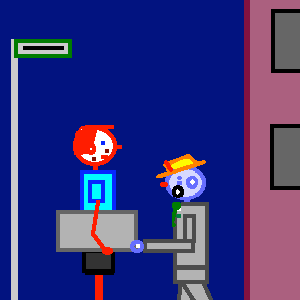
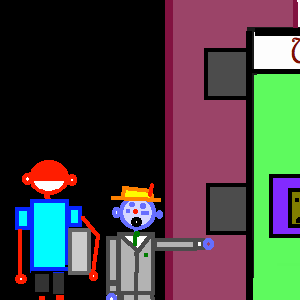
“What was that?” said Mr. Jones.

“Pardon me?” I said.

“I heard a voice. Like a girl’s.”
He spoke more quickly now, with fewer and shorter pauses.

“A slightly muffled voice,” he said, “but still --”


“Just the breeze,” I said. “In the trees.”

He looked up, around, then down.


“Can it be I’m finally losing my mind?” he asked. “At the age of eighty-three?”

There was a light on in a yellow fixture above the doorway, and I could see the consternation in the old man’s eyes.


Above our heads the branches and leaves of a tree made a hushing sound. The crickets continued to snicker, and from inside the house came the sound of a television set, Saturday Night at the Movies I think, they were showing Sayonara tonight. Various gnats, mosquitoes, and other insects added their respective parts to the evening’s symphony. But none of these sounds could remotely be mistaken for the small voice we had both just so clearly heard.


“Well, let’s get you up to your room, Mr. Jones,” I said, with attempted bonhomie.

“You went insane, didn’t you, Arnold?” he asked, not budging.

“Well, I did have a slight nervous breakdown last winter,” I said, shifting my weight around on my Keds. “But I’m much --”

“I heard you were hospitalized for three months.”

“Not quite three months,” I said.


“And you weren’t able to go back to work on the railroad.”

“Well, I did go back --”

“And they sent you home again, didn’t they?”


“Well, yes.”

“So did you hear voices?”

He was swaying again now, facing me, swaying back and forth on his heels, holding his cigarette at shoulder height.


“Yes,” I said. “I heard voices.”

“So I’m going mad.”

“Not necessarily,” I said.


“No?”

“No,” I said, trying to put at least an ounce of conviction in my voice.

He paused, taking a drag of his Old Gold, staring off into the darkness with his filmy old eyes, his body swaying gently, forward and back.


“Good night’s sleep you’ll be fine,” I posited.

“I haven’t had a good night’s sleep in ten years,” he said. “Fifteen years.”

I had no response to this. Now he looked straight at me, into my eyes.


“So this is how it ends,” he said. “Dementia.”

I stood there, holding the doll box. At least she was keeping quiet through this, for the time being, I thought.

But then:

“Try not getting absolutely drunk every single night of your life,” she said. “Then perhaps you won’t hear any strange disembodied voices.”


“What?” he said.

“Pardon me?” I said.

“You didn’t hear that?”


“Um --”

I struggled with a moral quandary. I could admit that I had heard the voice also, which would be admitting that I was insane, or I could deny having heard it, which would be tantamount to telling Mr. Jones that he was insane.

But then I remembered that he was drunk; chances are he would remember none of this.


“I didn’t hear anything,” I said.

“A voice just suggested I stop getting drunk every night. Or at least not absolutely drunk.”

“Oh. Well -- maybe it was, uh, just -- uh --”


“What?” he demanded.

“The voice of reason?” I offered.

He stopped swaying. He looked at his cigarette. He opened his fingers and let it drop to the old flagstone at our feet. The cigarette bounced, shooting up tiny sparks, and rolled off the slate into the grass, still lit and smoking. I stepped over, ground it out with the sole of my sneaker.


“What am I supposed to do if I don’t drink?” asked Mr. Jones, opening his arms as in supplication.

This was a question I’d asked myself often enough.

“You could read,” I suggested.


He stared at me.

“You know -- books, Mr. Jones,” said the doll.

He flinched ever so slightly.

“Yes, books,” he said, after a pause. “I used to like to read. Jack London. H.G. Wells. O. Henry. Even some of these newer authors -- Hemingway, Sinclair Lewis, James Branch Cabell -- although I must say my favorites among the younger boys were Zane Grey and Edgar Rice Burroughs...”


“You can still find their books,” I said.

“Yes. Yes, I suppose I could.”


“You could even take them out from the library. Wouldn’t cost you a dime.”

“Yes, true, true. But --”

He took one of his long pauses here.


“Get to the point!” said the doll.

“Well,” said Mr. Jones, “isn’t it a bit pathetic to spend one’s last days reading? Reading instead of living?”

“Is it any less pathetic just to get drunk every night?” (This was me, not the doll.)


Mr. Jones paused again.

I realized that a mosquito was feasting itself on the tender flesh on the reverse side of my left knee. I refrained from swatting him. I didn’t want to spoil the mood, and after all the mosquito was only doing what it had to do.

“You have a point,” said Mr. Jones.


"I do?" I asked.

“Getting plastered every night is no great accomplishment,” he said.


He then resumed his gentle swaying, back and forth, staring off into God knows what.

The mosquito continued to draw my blood.

Both the doll and I remained silent.


End of Part Four


part 5


Friday, January 14, 2011

dialog...

by
Francis Scudellari (even stanzas)
and
nooshin azadi (odd stanzas)


.

1
she opened the everyday window
a cypress tree was descending
the mist-covered hills of faraway

2
He strode through the humdrum flat where grays played
above and below. One watchful bulb pushed amber
smiles between patchy leaves and shamed an absent sun.

3
a black bird detached itself from the cypress tree
deliberately dissolving in the never-dissipating mist above
she turned back facing the rampant rug down below
 
4
The troglodyte cherub long dwelling in his dull
damp sensations, stirs to feel the creep-down warmth
of these lesser beams brimming a lost possibility.

5
the wavering rays of a meager lamp were lost in the silent symphony
of the colorful knots as she faced the opened window another time
the mist was not a blanket anymore but a web with a billion eyes

6
A fledgling finding its wings, he sought succor inside
basket-woven branches where the leaves now thickened red.
Their thousand tongues each wagged one warning: Your journey’s
just begun; beware the powerful snare of these mirages.

7
the black bird reappeared out of the blue
it kept appearing and disappearing again and again
as if stitching two worlds together

8
“Aren’t you just a figment too?” He asked, feeling devilish.
“I’d rather fly forever satisfied with airy lies
than be grounded by rocky, hard-to-discern truths.”

9
she knew both worlds were lecherous lies
always taking something away from her
she lived in the giving truth
a membrane between the two

10
All their disquieting peace had already been spoken,
and from an empty rustling one seed twirled, twilit
to sow dissonant hues between what he see-saw felt.
With eyes eased shut and breast bumped ajar, he left.

11
all day long she could hear some footsteps permeating through the membrane
they came dizzily and left hurriedly never lingering more than a smile
and when they were gone, a new eye in the mist would open

12
Afoot in a distant squint he spotted the humped backs
of hillocks, whose gently sloping slides he might climb
to change his stride and find more knowing whisperers.

13
 the eyes were all as silent as a seed
either flickering agitatedly with a story
or simmering down in a dream
she sat all day long looking into them
running the golden thread of the stories through the pearly drops of dreams

14
The picked road chose to imperceptibly dip
before it would ever-so-gently rise. In its subtle
sagging sat a toad of uncompromised bulk,
and he crouched to hear the wisdom of warted sighs.

15
there was no end to the stories nor to the dreams
thus no end to the threads running through the pearls
she hung them in her window where they swayed in the breeze
and the passers-by could hear their songs - if they listened

16
From the throbbing pouch of its throat came a rumbling
mishmash of a song. “Not all sounds sing, at first hearing.
Nothing grasped can be held long. The prettiest
stones are also the most slippery. We’ll all dive in.”

17
she was watching the pearl hangings in the breezeless window when she heard
a distant song with a bumpy rhythm and a pebble-in-the-pond ending
she knew the song and the singer but not the silent listener
another eye in the web, she smiled wryly, or a web in the eye?

18
Then the toad’s muted brown shape fizzled to drown
in the ripple-blown glass where, once again becalmed,
small milky spheres appeared to hang and point his gaze
back toward the hills, their magically hidden denizens.

19
there was a long silence then
brimming with pulsating little waves
torpidly traveling through her
just to die in the now singing pearl hangings

20
The steep he climbed with slow but steady steps
as the sun slid behind far-off twin bulges.
Hushed by crimson shadow, they hinted at lively
cheeks, a blushing face to tease his picked-up pace.

21
the waves
the songs
the pearls
the threads
the stories
the dreams
the mundane membrane
new foreign footsteps
her gaze followed the hills stretching over the usual misty horizon
the descending cypress tree was now so far away from them
for the first time her mind couldn't only watch
she wished the footsteps would never arrive
or if they did, they would never leave

22
Clumps of weeds and grasses ate away at the road.
Trunks, both straight-backed and curved, joined
bushy greens to gobble down the once-thick air
and prop up a big-top canopy, where
a kaleidoscopic chorus
whistled,
tittered,
squawked,
and chirruped
so he wished this walk would never end
or if it did, he would never leave.

.

september 19-28, 2010

Thursday, January 13, 2011

“A Town Called Disdain”, Episode 58: warm guns


Master yarn-spinner Larry Winchester returns us once again to those thrilling days of yesteryear, September 1969 to be exact.

Woodstock, the Moon landing and the Manson murders have all gone down the previous summer, while “Sugar, Sugar” by the Archies continues its relentless climb to the top of the pop charts.

It is not quite midnight, not too far from a wretched little town called Disdain!

(Click here to read our previous thrilling episode; newcomers may go here to return to the first chapter of this epic of which Cormac McCarthy has written {In Man's Adventure}: "Some may call it trash, but I call it the one novel I didn't write that I wish to hell I could say I had written".)


Grupler was determined to bring matters to a head, and tonight if possible.

Caution and planning and chess-like mind games were all well and good in their place but when it came right down to it what Grupler and Marlene really loved was action, violent brutal action.

Certainly they loved money, but they loved it all the more through getting it by intrigue and treachery and murder, and no sooner would they make a big score than they would blow it on fine hotels, caviar, cocaine, champagne, high-stakes gambling and squalid affairs with beautiful languid young persons found sipping absinthe and smoking Silk Cuts in some chic café or lounging on some financially if not socially exclusive beach; and oh how many of these lovely young creatures would soon after be found washed up liked used condoms on that beach at dawn? Thus sated and refreshed, blood money spent, Grupler and Marlene would set out gleefully and hungrily on the plunder trail again.

They had been trailing the Ridpaths for two weeks now, watching, listening, biding their time, waiting for the propitious moment, but now they had wearied of all that. And besides, too many players were crowding the stage. The two CIA men -- Philips and Adams -- had been trailing Grupler and Marlene since San Francisco; Grupler was fairly sure Philips and Adams would not make a move until they thought they were sure exactly what he and Marlene were up to; but he was not quite so sure about this nice new couple, these “Baxters”.

No matter, the time for sophistication was over. It was time for mayhem. They would do some killing.

Hans and Marlene had parked the Range Rover behind a big barrel-cactus on a rise overlooking Paco’s Quonset hut and its little private cemetery of disemboweled cars. When they heard the Baxters’ car approaching they hid behind some rabbitbrush and watched as the Baxters’ car stopped and the young couple got out and came slowly up the hill, following the tracks of the Range Rover.

Mr. and Mrs. Baxter each had a pistol in hand.

So did Grupler and Marlene.


The coyotes started up their howling with the first shots and they were howling still as Grupler examined the dead couple’s credentials by the light of his penlight.

Oh ho, well: Lt. George Schotzbarger and Lt. Myreka Putcheko, agents of Q Section, friend Ridpath’s old outfit.

Grupler’s nostrils flared with pleasure at the smell of fresh blood in the pristine desert air and he felt full of life.

Then there was another sound and Hans and Marlene turned and saw Philips and Adams’s dirt bikes sputtering up the road down below.

Hans flicked off the light.

“Let’s use the dead ones’ pistols,” he said.

“This is fun,” said Marlene. It was true, for all Grupler’s faults she loved him in moments like this.

They snatched up the Baxters’ pistols and scurried back behind the bushes.


Philips and Adams stopped their bikes by the Baxters’ car. They looked up the hill and saw what looked like two dead bodies.

“All right,” said Philips, “let’s get to the bottom of this.”

“Right,” said Adams, drawing out his pistol and racking the slide.

“No more kid gloves.”


They had no sooner realized that the two people they found lying on the hill were the Baxters and that they were indeed dead than they were dead themselves.


Grupler and Marlene put their own pistols into the dead hands of Philips and Adams and then went back and put the Baxters’ pistols into the Baxters’ hands. Then they gathered up their spent cartridge casings and scattered them playfully about the bodies.

“So sad,” said Grupler. “A regrettable instance of U.S. government agencies not working fully in concert.”

Hans and Marlene kept Philips’ and Adams’s guns and ammunition, and started down the hill on foot toward Paco’s house.

The coyotes had never stopped howling, and they didn't stop howling now.

****

(Continued here, and until the final showdown.)


Tuesday, January 11, 2011

i'm still a child...

.

death is drizzling
towering powers are decorated with caring corpses
proud-covered monotonous lines meet
planes crash horizontally
dots die undramatically
roads lie
leaders leak
polluting the soul
jealousy is still snowing
bleak bells jingle
poets compete to wear the emperor's new clothes

.

Monday, January 10, 2011

2 early poems

by horace p sternwall

illustrated by rhoda penmarq


madness


doctor, am i going mad?
please be the friend i never had
tell me, are things what they seem
or are they only just a dream?

doctor, doctor, please tell me
is this life but a fantasy?
why in all the wide world free
must only i have eyes to see?

now am i afraid to sleep
lest creatures from the the swirling deep
rise up and swallow not just me
but all so-called humanity

why must i who had such faith
be now a disappearing wraith?
why must i lie in this dark room
my brain the screen of universal doom?


*


at the club


my grandfather soames
who made the family fortune
had difficulty getting his point across
to my grandmother emily

or to women in general
or to servants, foreigners, cab drivers, birds, cats or even dogs
but with horses and men of his own class
he got on very well indeed

when the automobile replaced the horse
he was devastated
and never really recovered

his eldest son, my cousin edmund
who had heretofore
(am i using that word correctly?)
languished in his father's shadow
became a champion race car driver


and quite the most famous
member of the family
his exploits had to be followed
in the new york times

because the transcript, of course
regarded them as unworthy of notice
i could go on in this vein for a while yet
but i fear that i am boring you

please forgive me
would you like another drink?


*


Saturday, January 8, 2011

clarissa the doll, part 3

by arnold schnabel

edited by professor dan leo

illustrated by rhoda penmarq and konrad kraus

executive producer: kathleen maher

part three of fifteen

to begin at the beginning, click here


Part Three


After my customary sigh I was about to reach for the door handle again when I had a cautionary thought.

I raised the box up with the palm of one hand, and with the thumb and forefinger of my other hand I lifted the lid just enough to peek in.

“Do me a favor,” I said. “And just be quiet in front of my friends.”


“Certainly. And you will do me the favor of taking me out of this box when we get inside. I’m sure your friends would be delighted to bask in my beauty.”

“Well, okay,” I said, just as two coast guardsmen came out of the door amidst a wave of music and badinage and laughter from within.

I made a coughing sound, fumbling the lid closed and shifting the box back under my arm, all in an absurd attempt to disguise the fact that I had just been conversing with a child’s doll, but luckily the coast guard boys were paying no attention to me, or, even if they had noticed my insane behavior, they just didn’t care. At any rate they ignored me and walked off.


“Close call!” she said, from within the box.

I grabbed the handle of the door before it could close, but I wasn’t going to get into the Ugly Mug that easily, because just then an old man pushed or fell against the door from inside, stumbled right into me and at once began to slide down my body towards the pavement while his hands scrabbled weakly at my arms.

Was I never to be set free from little old men this night?


Keeping the doll box under my right arm, I bent down and raised him up by grabbing him under his upper right arm with my left hand.

“Woops,” he said.

I knew him by name, or at least by his last name -- Mr. Jones. I had seen him often around town, usually in some bar or other, always neatly dressed in a grey suit and a little straw fedora with a feather in it.


“Thank you, neighbor,” he said. And then, after a pause: “Do I know you?”

“I don’t think so,” I said.

The door of the bar closed behind him on its hydraulic closing mechanism, shutting away the sounds of merriment.


“I’ve seen you around,” he said. “You’re the Schneider sisters’ nephew, right? Arnold, isn’t it?”

“Yes,” I admitted.

I tentatively let go of his arm, and he didn’t fall down.


“It has been suggested that I go home, Arnold.”

“Oh. Well, good night then.”

“I’m eighty-three years old.”


“Oh, well, that’s great,” I said, in all my insipidity.

“Eighty-three years old.”

“That’s uh, really great,” I lied through my teeth.


“Eighty-three years of age.”

“That’s, um --”

He smelled like whiskey, and tobacco, like an old National Geographic.


“Eighty-three,” he said. “But I’m finally starting to learn my limit.”

He stared at me for a few moments, swaying just slightly, then he shifted his gaze to the box under my arm.

He tapped the lid.


“What’s in the box?”

“It’s -- um --”

“Nothing!” piped the doll, slightly muffled by the box.


“What?” said Mr. Jones.

“What?” I said.

“Did you hear something?”


“No. No, I didn’t hear anything,” I said, “in particular.”

“Odd,” he said.

Suddenly he began to wobble, like a marionette whose puppeteer has begun to doze off.

I stuck my free arm under his right arm, again, and yanked him up against my side.


“Mr. Jones.”

“You know my name.”

“Yes,” I said.


“Take me home, Arnold. I seem to have a drop too much partaken this evening.”

My heart sank. It was true, I would never make it back into the bar tonight. Elektra would think me insane. And she wouldn’t be wrong.


“Where do you live, Mr. Jones?”

“Just up the way there,” he said, pointing vaguely up Decatur Street in the direction away from the beach. “Not far. Not very far.”

“Okay,” I said. “But look, I just have to check in with my friends in the bar here, okay?”

“Yes.”

I let go of his arm.


“I’ll just be a minute,” I said.


“Of course.”

“So just stand here.”


“Certainly,” he said, but then he began swaying again, in a circular motion, so that the only question was not whether he would fall but in which direction.

I grabbed his arm and steadied him.

“Okay,” I said. “Let’s just go.”


“Right. Let’s go,” he said, and off we went, with Mr. Jones hanging onto my left arm.

We crossed Washington Street; it seemed as if I had already crossed at this intersection dozens of times this evening.


We walked slowly, and he only stumbled and began to fall perhaps every third step or so.


He began to speak, coherently, but slowly, pausing between each phrase, each sentence. Sometimes he would pause between words within a phrase, or even between two syllables of the same word. Sometimes a pause would last so long that I thought he might have abandoned his train of conversation entirely, but then suddenly another phrase or word or syllable would emerge from his papery old mouth, to be followed by yet another pause.

“This is what I do,” he said. “I drink. And talk to random strangers. In the mornings I suffer. I take a bath and smoke cigarettes with a wet rag over my eyes, and then I go to a coffee shop and eat bacon and eggs and drink copious cups of coffee while reading the previous day’s Philadelphia Bulletin in its entirety.


If my name is not listed in the obituaries I go to my room and rest and dream of my life such as it was and is. Then I get up, get dressed and go out and get drunk again. Turn down Lyle Lane here.”

Slowly we went down the lane, which, although it was only a block from Washington Street, was dark and quiet, covered over with the gently stirring leaves of old trees.


“I see you’re limping, Arnold. How did you hurt your leg?”

I had forgotten about my leg, but now that he mentioned it I was indeed limping, and my leg hurt. How had I managed to do all that running and carrying with Mr. Arbuthnot? Pure adrenaline I suppose.

“You don’t have to tell me,” he said. “It’s none of my business.”


“It was an embarrassing accident,” I said.

“Say no more.”

He stopped suddenly.


“Is this where you live?” I asked.

“No. I want a cigarette.”

He disengaged his arm from mine and slowly brought a pack of Old Golds out of his side jacket pocket. He poked into it with his old fingers and began to extricate a cigarette, and as he did he teetered gently back and forth. I stood ready to catch him if need be. Finally he got a cigarette out and into his lips. He re-pocketed the package of cigarettes and began patting his pockets.


“Do you have a light?” he asked me.

“No,” I said. “I’m quitting smoking.”

“Very sensible.”


He continued to pat and to search his pockets.

I became aware of the sound of crickets snickering in the darkness, and of lightning bugs flicking on their little greenish lights and diving up and down like tiny roller coaster cars.

Finally Mr. Jones found a book of matches. To speed things along I took the book from his fingers and gave him a light. They were Sid’s Tavern matches.


“Thank you,” he said, and then coughed.

I handed him back the matches, and he dropped them into a jacket pocket.

He put his arm in mine and we resumed walking. After about five or six more feet he gestured to the left with his cigarette and said:


“There’s my boarding house, here.”

It was a large dark old Victorian house, like hundreds of others in town, maybe a little more run-down than average. The front gate of the picket fence was open.

“I can make it from here,” he said. “Thank you, Arnold.”


“You’re welcome, Mr. Jones.”

He stumbled backward, almost fell against the gate post, but I grabbed him by the arm again.


“Woops. Thanks,” he said. “I’m okay now. Good night, sir.”

“Mr. Jones, may I ask on what floor you live?”

“Third floor, but I’ll be fine.”

“Come on,” I said, and keeping my hand on his arm, I led him up the cracked slate path.


“Take me around to the side entrance,” he said.

We passed under an enormous weeping willow. Its tendrils slithered against my face.

“So, the box,” he said.


“Yes.”

“What’s in it?”

“It’s a doll,” I said.


“Ah.”

We went around to the side of the house. The warm air smelled of honeysuckle and of moss on old bricks.

We came to the side entrance.


“Just right in here,” he said.

“I wouldn’t go in there,” said the little voice in the box.


End of Part Three


part 4