Pages

Monday, December 6, 2010

another song

by jack dale coody

illustrated by rhoda penmarq


my poems are free, and so am i
whatever flies in the windswept sky
can hear my song - absolutely no charge
i'm the bard-ambassador at large


i've worn out a thousand pairs of shoes
i've rocked on the rails and been rolled by the muse
through georgia dust and wyoming hail
i've defied the world to tell my tale


judges and congressmen with their laws
auxiliary ladies with their fancy gewgaws
the diplomats in their pinstriped suits
can look down their nose - i don't give a hoot


my poems are free, and so am i
i wear no gucci shoes, no brooks brothers tie
keep your nobel prize - i'll save my words
for the midnight highway and the hummingbirds


Saturday, December 4, 2010

Thursday, December 2, 2010

“A Town Called Disdain”, Episode 52: that feeling

Return with us now to that strange land known as the past as Larry Winchester gracefully affords us a glimpse into the backstory of that charming adventurer Dick Ridpath, in this, our exclusive serialization of the “director’s cut” of the sprawling epic Harold Bloom called “perhaps the most important novel written by an American since Richard Stark’s The Hunter”.

(Click here to read our previous episode. Go here to return to the far-off misty beginning.)


This feeling of being watched.

To survive at his former trade Dick had done his best to nurture and develop a capacity for this feeling. But back then he had at least usually had a good idea of who might be watching him, and why. At least up until around the time of the Bay of Pigs, anyway.

By that time Dick considered it his misfortune that he just happened to be good at blowing up things and killing people. This business of the CIA occasionally “borrowing” Dick from the navy for “black” missions began back in ‘54, when he was still with the Underwater Demolition Teams, and it had continued after Dick transferred to field operations in Naval Intelligence and then to Q Section (or, as it was officially known, the Naval Office of Comparative Statistics). These missions often involved some sort of mayhem, and he had done his job each time with the same proficiency he tried to bring to every job he did. Some people were just good at things, and Dick just happened to be good at swimming or paddling into places undetected, at blowing things up and killing people and whatnot and then getting away scot free. But he was never crazy about the killing. Bumping off a local Communist Party Commissar in some Third World hellhole was not his idea of good kicks.

So Dick was not happy when he was posted down to Guatemala in March of 1961, to help train the Cuban expeditionary force. He just wasn’t interested in this sort of thing any more. Besides, he was a Q Section man now, and Q Section had gone way beyond the crudities of C-4 and the revolver and the knife.

Of course the CIA was not even aware of Q Section’s existence and had no idea that over the past few years Dick’s duties had concentrated on drug experimentation, ESP, telekinesis, Oriental methods of mind and body control, out-of-the-body travel, and investigations into the possibilities of extraterrestrial intelligence.

But still he had never quite been able to shake this reputation as a good “wet boy” -- that is, a killer -- and so the CIA continually requested his services for some sort of nastiness or other.

Usually he managed to get out of it, but if Admiral Quigley -- the founding chief of Q Section -- personally asked him to oblige, well, then Dick felt he had to.

But sometimes the Admiral would allow the mission, and then instruct Dick to disrupt or alter the mission in some way. Like the time in Ankara when he put a bullet through the brain of a top CIA asset who unbeknownst to the CIA was a mole employed by the Russians. Dick arranged it so that the CIA thought the man had died honorably, probably assassinated by Hans Grupler (who in fact had been the man’s Soviet Bloc contact). This affair had been just another of Dick’s and the Admiral’s little secrets.

The month before he went down to Nicaragua the CIA had wanted Dick to swim into Havana Harbor underwater and fix a Hagenson pack full of gelignite and cyanide-soaked needles to a fishing boat that Castro was supposed to visit. Dick had managed to get out of that assignment; but now they just had to have him for this new Cuban thing. The Admiral reluctantly assented, and, well, orders were orders, and the Guatemalan mission was supposed to be merely a training one. After only two days however he had requested -- no, demanded -- to be relieved. It was an incredibly shoddy operation, even by the CIA’s notorious “gentleman adventurer” standards; he could smell a bloody fiasco and he wanted no part of it.

He got the transfer back home, but looking back on it Dick could see that this had been the beginning of his fall from grace. It was right around this time that he first got the feeling that the atmosphere around him had changed, and that he was being watched and investigated by members of his own government, his own service.

And then one night he saw with his own eyes that at least one of his colleagues was nosing quite improperly into his affairs.

It was shortly after his return from Guatemala, and Dick had come into the Q Section warren after hours to grab his bag of Ben Hogans for a round the next morning. As he turned down the dimly lit corridor to his office he noticed light spilling from his doorway. He slipped off his shoes and took his Smith & Wesson Airweight out of his jacket pocket. Hugging the wall, he went slowly down the corridor and stopped at the doorway. He peeked in through the crack between the hinged side of the door and the jamb.

What he saw was disquieting to say the least.

It was that weasel Pym, his supposed brother officer and “friend”, sitting behind Dick’s desk, rummaging through the drawers with his left hand. Pym was breathing very heavily and Dick could not be sure because the desk was in the way, but it looked horribly as if Pym were masturbating with his right hand. Dick put his gun away, walked softly back down the hall, picked up his shoes and left, without his golf clubs.

Now on the one hand Pym could just be a nosy pervert; actually Dick was pretty sure Pym was a nosy pervert. But besides being a weasel and a pervert Pym was also Vice Admiral Hackington’s private jackal.

Dick got along famously with Admiral Quigley, but he had never liked his second-in-command, Vice Admiral Hackington, and Dick knew the feeling was mutual. Hackington was one of those guys who was born with a poker up his ass and was proud of it, and he had only gotten worse after that weekend he and and Admiral Quigley and Dick had spent with Professor Leary in Cambridge.

In fact Hackington had pushed to send Dick down to Guatemala. He hadn’t liked Dick’s resistance to the assignment, and he liked it even less when Dick requested to be relieved. When the Bay of Pigs action turned out so disastrously he almost stopped speaking to Dick entirely. And Dick continued to find evidence of rummagings in his office. One time he even noticed what looked alarmingly like semen stains on the linoleum under his desk.


Dick was glad when the Admiral approved his request to study in Nepal for a year. It was good to get away from navy and CIA politics, and from creeps like Hackington and Pym.

While he was away Admiral Quigley died -- a boating accident -- and Hackington took over Q Section. The little jackal Pym was made Operations XO, and when Dick returned he found that Q Section had sadly changed.


In January of ‘65 came Dick’s alleged “disappearance” in New Mexico, followed closely by his strange kidnapping (and even stranger release) by “foreign elements”; things got to the point where he felt he really had no choice but to resign his commission.

He would explore life and the world on his own now, no one looking over his shoulder, no one giving him orders. And that’s the way it had been, for four chaotic but rich years, the Daphne years.

But now he was being watched again, there was no doubt of that.

But by whom? And why?

He was damn well going to find out.

Should he simply confront this clean-cut nice young couple, these “Baxters”, as he had Philips and Adams?

No.

Wait.

Wait and let them come to him.

He felt very alive right now.


(Continued here, and until we get to the bottom of this nonsense.)

7. it was on top of the cypress tree that crow learned how to fly

.

crow was sitting on top of the cypress tree
cawing about all it could see
down below
and up above

they were walking on the forgotten earth
listening to crow
but watching the picture reflected
in the mirror they were holding
in front of their faces

.


and seven is an end... each end a beginning...
/nooshin azadi/

6. it was raining when crow learned how to forgive

.

the sun was absent
rain was washing away
the hunter's footprints
on the blood-stained soil

.

5. it was by the pond that crow learned how to pause

.

the pond was as still as the stones
the world was upside down
the higher it soared
the deeper it sank

.

Wednesday, December 1, 2010

an unfortunate accident: part 2

to begin at the beginning click here

by dan leo

illustrations by konrad kraus

part two of four

(Extracted from Arnold Schnabel's 37-volume memoir, "Railroad Train To Heaven")


“Well, it’s just that --”

“Your little -- friend?”

“Yes,” I said.

She continued to hold my hand on her breast.

“Persephone is it?”

“Elektra,” I said.

“Are you going to marry her?”


“I doubt it,” I said.

"Why not?"

"I wouldn't want to inflict myself on her," I said, in all modesty.

"Oh, yes," she said. "This alleged breakdown of yours."


"It's not merely alleged," I said. Her breast was warm, and moist, but I suppose no more warm nor moist than my hand was.

"I don't give a damn about your breakdown," she said. "Pardon my language."

"Of course."

Despite myself I felt those ancient stirrings down below.


“Wait, did you hear something?” she asked.

All I could hear was the clattering rain, well, that and Mrs. Biddle and myself of course.



She pulled my hand away from her breast and laid it, my hand, on the table.

I reached over for one of the cookies, it looked like a butter cookie.


“Oh, dear,” she said.


She was looking over my head. Putting the cookie between my lips and biting into it -- it was indeed a butter cookie, crispy and delicious -- I turned and saw a large blond-haired fellow in a disheveled and wet white suit come out onto the veranda.

"Hello, Jimmy,” said Mrs. Biddle. “You’re back early. How nice. Do you know Mr. Schnabel?”


Jimmy said nothing at first. He stood there in his wet linen suit, a faint steam rising up from his great round shoulders. He looked like a man who had played fullback in college but who hadn’t exercised in the fifteen years since his graduation. He swayed just slightly, staring alternately at Mrs. Biddle and myself. His eyes were small but with large black pupils.


Swallowing my bite of butter cookie I stood up, wiped my hand on my trousers and then extended it, my hand, to him.

“How are you?” I said. “I don’t think we’ve met.”


He stared at my hand.

“Whatcha doin’ here,” he said.

I could now smell the alcohol fumes wafting gently from his large body, admixtured with those of cigars and sweat and what I now recognized as female sexual exudation.

“Mr. Schnabel simply stopped by for a visit,” said Mrs. Biddle behind me.

I brought my unshaken hand down to my side.

“You’re that nut,” said Jimmy, to me.


“Jimmy,” said Mrs. Biddle.

“I heard about you. Railroad man. Went nuts. Are you nuts?”

“Jimmy,” repeated Mrs. Biddle. “Stop it.”

“What are you doin’," he said to her, "having tea with this lunatic?”


“He’s recovered. Or recovering. Be polite. Mr. Schnabel is our guest.”

“I didn’t invite him. I go away for a few drinks at the club and you invite some nut case in for tea.”

“Stop this nonsense, Jimmy.”

“You,” said Jimmy, pointing a large bloated finger at me, “Beat it. Hop it. ‘Fore I throw you out.”

“Okay,” I said.

“Arnold,” said Mrs. Biddle. “You don’t have to go. Jimmy, you’re drunk. Go to your room and lie down.”


“Shut up,” said Jimmy. He was still pointing at me and now he stepped forward and poked me in the chest with that big finger. “Scram,” he said.

“Sure,” I said. I turned to Mrs. Biddle. “Thanks for the tea and sandwiches, Mrs. Biddle. And the cookie.”

“Don’t go, Arnold. Don’t leave me with this beast.”



Suddenly something -- I suppose Jimmy’s ham-like paw -- shoved mightily against my shoulder and I tripped over the tea table, sending it and the tea service clattering and shattering onto the floor. I staggered several steps but managed not to fall down. I turned and Jimmy was rushing toward me making a sound like a man who was having his arm twisted behind his back, but in fact both his arms were raised and his hands were clenched into fists. I could hear Mrs. Biddle shout as Jimmy rushed at me raising his right fist high over his shoulder,


but fortunately for me he slipped on something, I think it was the silver tea tray, and I stepped to one side as he stumbled past me and crashed through the screening and into that almost solid wall of rain.


I stood there looking at the big jagged hole he’d left in the screening. The only sound now was that of the rain, this wet cacophony as if some ocean in the sky had decided all at once to come crashing down to drown the earth forever.

“Oh my God,” said Mrs. Biddle. “Are you all right, Arnold.”

“Yes, I think so,” I said.

I looked at her, she was still sitting on the wicker sofa, but sitting up very straight, with her fists clenched close to her breast.


“Go look, see if he’s okay. He’s such a bull. I’m sure he’s okay.”
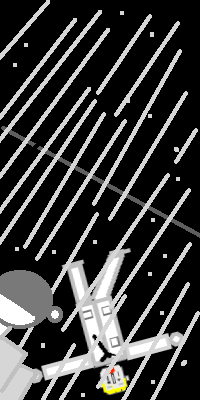


I went over to the edge of the veranda and looked down through the torn space in the screening. Down through the torrents of rain I saw Jimmy’s pale form lying absolutely still in the mud of the yard.

“Is he okay?” asked Mrs. Biddle.

“He’s not moving,” I said.

“Oh,” she said.

I moved back a bit from the verge of the veranda. I had been getting wet.

“I’ll go down and check on him,” I said.

“Wait. Let me look.”


She got up, stepped over the tea things on the floor, and came over next to me. She put her hand on my arm and leaned forward, looking down.

“He’s not moving,” she said.

“No,” I said.

“He’s not moving at all.”
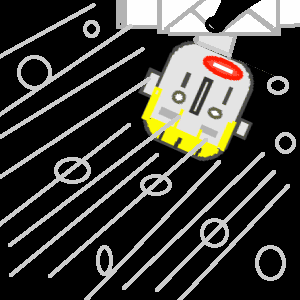


Continuing to hold tightly onto my arm she leaned farther over, holding her other hand over her forehead to keep the rain out of her eyes.

“I think his neck is broken,” she said. “Look, Arnold.”

I didn’t want to, but I did, shielding my eyes from the rain with my hand. It was true, his head was twisted at an unnatural angle. He looked like some enormous puppet dropped in the mud.


Then we saw a man in a white suit come out of the house, carrying a black umbrella. He came down the steps, went over to Jimmy and knelt down next to him on one knee. All we could see was this large black umbrella, and the bottom half of Jimmy’s unmoving body.

Then the man stood up and tilting the umbrella towards his back, he looked up at us. It was Tommy.

“How is he?” called down Mrs. Biddle.

Tommy called up something but the downpour drowned out his words.


“What?” called Mrs. Biddle. “How is he, Tommy?”

Tommy called louder this time, cupping his hand to the side of his mouth:

“I'm afraid he’s dead, Mrs. Biddle.”


She paused, then straightened up and looked at me.

“It was an accident, Arnold. There was nothing either of us could do."

She had continued to hold onto my arm, but now she let go of it.


part three